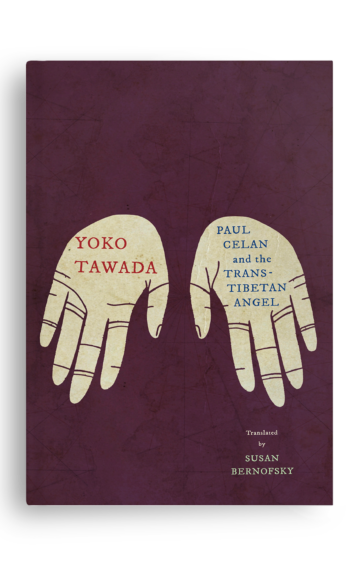
- Publisher: New Directions
- Available in: Paperback, Kindle
- ISBN: 978-0811234870
- Published: July 9, 2024
Published in the UK and many other countries as Spontaneous Acts
Longlist, 2024 Barrios Book in Translation Prize, National Book Critics Circle
“[A] poignant ode to artistic inspiration… Readers will fall in love with this inventive and deeply human story.” —Publisher’s Weekly
“[A]n inventive homage to modernist literature, wrapped up in an unexpectedly personal depiction of illness… A dark but charming portrait of a man unmoored by his love of an artist.” —Kirkus
“Bernofsky reunites with Tawada for a fourth title, proving again to be extraordinarily adept at distilling Tawada’s enigmatic, exacting, German-specific wordplay into an impressively gratifying anglophone experience… [A]n esoteric, erudite lull before a brilliantly shocking revelation.” —Booklist
“A keen observer of cultural and linguistic dislocation, Tawada has absorbed a kind of anti-language from Celan, a deeply affecting, sui generis diction unmoored from nationality or obvious tradition.” —New Left Review
“Tawada’s Paul Celan and the Trans-Tibetan Angel reads almost like a cautionary tale…this is what happens if you devote your life to poetry” —Harper’s
“Set in a hazy, post-lockdown Berlin, Tawada’s trademark dream-like prose follows the story of Patrik, an agoraphobe rediscovering his zeal for life through an unlikely friendship built on a shared love of art.” —The Millions
“Patrik’s perspective is mirrored in Bernofsky’s translation, with its perfectly balanced tone of dry humor and tenderness.” —Words Without Borders
“Most impressive to me is how deftly Tawada establishes the antitheses, scope of concerns, and voice of this 1st/3rd person and his jittery world, all of which has the symmetry and clarity of realism. Susan Bernofsky’s acutely attuned translation delivers these qualities.” —On the Seawall
“This is narrative, not programmed and plot-driven, but as freedom. Even conventional narrative tools like character prove spectral; the protagonist’s identity shifts fluidly between first person, third person, and the perspective of other characters in a way that feels thrillingly brave.” —Australian Public Broadcasting Corporation
“Linguistic wizardry… The genius of Yoko Tawada is to dramatize how speaking in tongues, tearing language from its roots, may offer the best option for humanity under ever-worsening threat.” —The Brooklyn Rail
“Tawada’s music-prose is a testament to the spirit of collaboration: to the miracle of being able to test, with and against another consciousness, how far a language might pass from one private recess to another.” —Asymptote Journal
“[A]n important novel well suited to its moment in history.” —Asian Review of Books
“Tawada is an artist out on the tip of the spear. She isn’t courting a readership, curating her image, coaxing popularity like some; she is pushing her art forward, and we as readers are welcome along for the ride if we can keep up. It’s startling, breathtaking prose, literature at its purest.” —The Japan Times
“[C]heerfully dystopian.” —Cleveland Review of Books
“Tawada taps into a central vein in the history of German aesthetics which ascribes a deeply political force to the totalizing Gesamtkunstwerk vision. ” —First of the Month
2024 Best Book: “[A]n absurd, dark, dreamlike narrative that meditates on warfare, religion, memory, migration, and belonging […] feverish, furious narration bewitching in Bernofsky’s lucent translation.” —Sana R. Chaudhry, The Paris Review
2024 Book of the Year: “a singular writer whose work defies genre and expectations.” —Mike Fu, The Japan Times